
Why visit
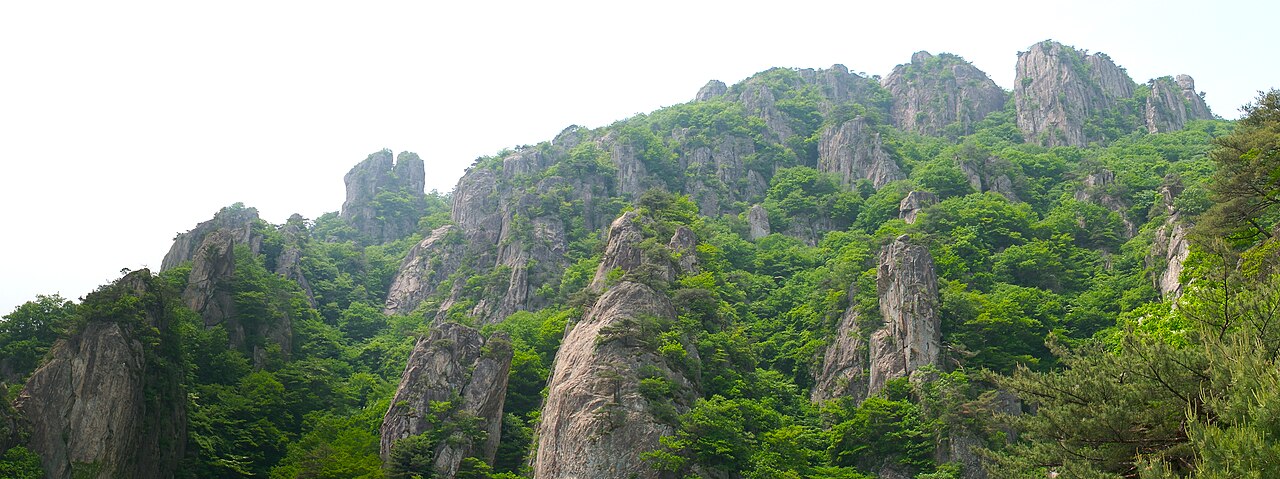
The Geumgang Gureumdari (금강구름다리) suspension bridge is 50 metres long and spans a sheer gap between two granite towers at around 670 m. It moves underfoot. The drop below is real. The views of the surrounding ridgeline open up in both directions and nowhere else in Korea gives you this kind of exposure without requiring a full-day technical climb. The bridge is the image people associate with Daedunsan and it earns the trip by itself.
Right after the bridge, the Samseon Stairway (삼선계단) is a bolted stainless-steel ladder going almost straight up a cliff face — 127 steps, railings on both sides, genuine height exposure throughout. People who are fine with heights find it exhilarating. If you are not, the cable car plus bridge combination is already a complete visit without committing to the ladder.
From Seoul, KTX to Daejeon takes under an hour. Bus from Daejeon East Terminal to the park entrance takes another hour. From the park, cable car up and the bridge-ladder loop is 1–2 hours. You can be back in Seoul before dinner. That logistical efficiency is a genuine selling point for the mountain — the autumn foliage in early November is among the best in the central-west region, and the fact that you can do it as a day trip keeps it accessible even for people with limited time.
Getting there
The most practical gateway is Daejeon. KTX from Seoul Yongsan or Seoul Station reaches Daejeon in roughly 50–60 minutes (about ₩22,000–28,000 one way). From Daejeon East Bus Terminal (대전동부버스터미널), buses to Daedunsan (대둔산) depart several times daily and take about 50–60 minutes (₩4,500–5,500). The bus drops at the park entrance near the cable car station. Check the last return bus before going up — services thin out sharply after 18:00, and the last weekday bus can be earlier than you expect. Jeonju is a viable base from the Jeollabuk-do side; buses from there to the Wanju entrance exist but run less frequently. Taxis from Daejeon to the park cost ₩35,000–45,000 and make sense for groups of 3–4 when buses are infrequent. No subway connection to the park.
At a glance
Elevation: 878 m (Macheondae 마천대, summit) Difficulty: 3 / 5 — cable car removes most elevation gain; Samseon Stairway is exposed but safety-railed Typical duration: 3–4 hours total with cable car + bridge + stairway + summit loop; 1–2 hours for cable car + bridge only Best season: Early November (peak autumn foliage); April (spring azaleas) Park status: Daedunsan Provincial Park (대둔산도립공원) — spans Chungcheongnam-do and Jeollabuk-do; not a national park Entry fee: ₩1,000–2,000 adults; cable car extra approximately ₩15,000 round trip (verify at gate)
Safety
The Samseon Stairway is 127 steps up a near-vertical cliff. Railings line both sides and the structure is bolted to rock, but the drop is real and the stairway is narrow. Do not attempt it in flip-flops or smooth-soled shoes, or if you have a fear of heights. Wet or icy steps become slick even with grip footwear — rangers may close the stairway in those conditions; check at the cable car station on arrival.
The suspension bridge is designed to move. In high winds the sway is pronounced and the bridge will be closed by rangers when wind exceeds safe limits — they will redirect you. Do not jump or run on it.
The cable car does not run until dark. Last car times vary by season — roughly 17:30–18:00 in summer, earlier in winter. Missing the last car means a full descent on foot. Confirm return times at the lower station before boarding.
Cell signal is good near the cable car and bridge. Patchier toward Macheondae. Download offline maps before arriving. For emergencies dial 119 (English relay available); 1330 for non-emergency assistance.
Map
Food on the trail
A row of restaurants and stalls lines the road below the cable car station. Doenjang jjigae (된장찌개), pajeon (파전), makgeolli (막걸리), and hotteok (호떡) are standard. Meals cost ₩8,000–13,000. Most open around 08:30 and wind down by early evening. On weekdays outside autumn foliage season some stalls may not be open at all — do not count on food being available when you return.
A small kiosk near the upper cable car terminal sells bottled water, instant coffee, and packaged snacks. Stock up here before the bridge and stairway — it is the last resupply point on the mountain.
Nothing is available on the ridgeline beyond the upper cable car station. Carry at least 1 L of water per person; the stairway and ridge push your heart rate up fast.
If arriving by car, CU and GS25 are in Nonsan and Wanju on the way in. Banchan at the trailhead restaurants often contains fermented seafood (젓갈) — mention shellfish allergies when ordering.
Packing tips
Grip shoes — mandatory. The Samseon Stairway and wet granite near the bridge are dangerous in smooth-soled shoes. No sandals. Gloves for the stairway (autumn and winter) — metal handrails get very cold; thin gloves make the climb noticeably more comfortable. Microspikes or crampons (winter only) — essential if snow or ice is forecast; rangers may bar entry to the stairway without them. Cash — park entry (₩1,000–2,000) and cable car fare (approximately ₩15,000 round trip) may be cash-preferred; have it on you. Fully charged phone — you will want the camera, and you need it for cable car last-car time confirmation and offline map navigation.
Best season
Late October–early November: The undisputed peak. Foliage typically crests in the first week of November — maple, oak, and sweetgum blazing against the grey granite. This is when Daedunsan draws its largest crowds. Arrive by 08:00 on weekends.
April–early May: Cherry blossoms near the lower entrance in early April; azaleas on the upper slopes in late April. Comfortable temperatures and good light.
June–August: Lush green and the cable car runs, but afternoon thunderstorms are frequent in July–August. Avoid the exposed stairway and bridge in lightning.
December–February: Snow on the granite cliffs is striking and the mountain is quiet. The bridge and stairway may be icy and could be closed — check with park staff on arrival. Microspikes recommended if snow is forecast.
Culture & history
Daedunsan (大芚山 — roughly "Great Pile-up Mountain") sits on the border between Chungcheongnam-do and Jeollabuk-do. Being far from either province's main centres has given the mountain a certain autonomy of character. The name itself describes the upper terrain accurately: enormous granite boulders stacked on top of each other in ways that look physically improbable. Walking the ridge makes it immediately obvious why the name stuck.
Several Buddhist hermitages and small temples occupy the flanks, including Taegosa (태고사), a temple with Goryeo-dynasty roots that clings to the rock face near the summit ridge. These are active religious sites. Hikers who push past the cable car zone and continue along the ridge toward Macheondae will pass monks and worshippers going about their practice, not posing for photographs.
Daedunsan's main cultural reputation in Korean hiking circles is for its autumn foliage — specifically the compressed intensity of colour that comes from having dense deciduous forest on the lower slopes and dramatic bare granite cliffs above. The combination in the first two weeks of November produces a display that serious foliage-chasers in Korea rate highly, comparable to what you get at Naejangsan but with more dramatic topography.
Frequently asked questions
›How high is Daedunsan?
Daedunsan rises to 878 m above sea level.
›How difficult is hiking Daedunsan?
The difficulty of Daedunsan is rated 3/5 (Moderate). Difficulty varies by trail, so check each course before you go.
›When is the best season to hike Daedunsan?
The best time to hike Daedunsan is Fall.
Have more questions? Ask the community on Connect Korea →