
Why visit
Haeinsa is the reason many people visit Gayasan, and it fully justifies the trip on its own. The temple houses the Tripitaka Koreana (팔만대장경) — 81,258 wood printing blocks carved in the 13th century containing the complete Buddhist canon, considered one of the greatest achievements of Korean craftsmanship. The storage halls (장경판전, Janggyeong Panjeon) that house the blocks are a UNESCO World Heritage site and a remarkable piece of pre-modern climate engineering: the wooden building's ventilation design has kept the blocks free of warping and mould for over 600 years. You can view the blocks through open slats in the hall walls.
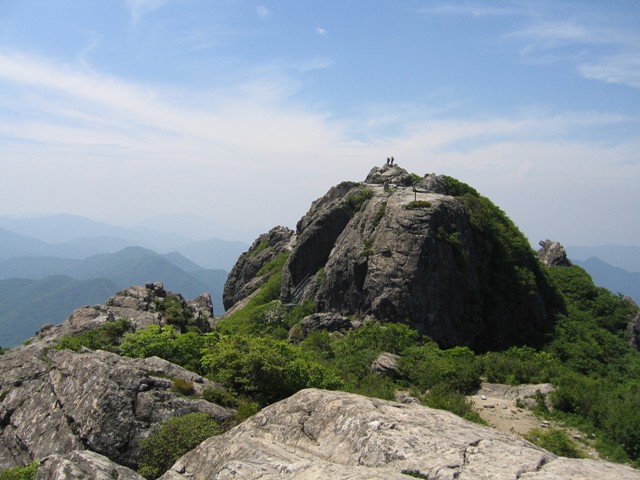
The mountain itself, above the temple, delivers dramatic granite scenery quite different from the temple approach. The upper ridge to Sangwangbong involves some exposed scrambling with rope sections. Views from the summit extend across the Gaya range and down to the Hapcheon reservoir on clear days.
For hikers interested in the full range experience, the Gayasan ridge connects to longer routes including the Baekdu-daegan trail system — useful for multi-day hikers who want to link Gayasan into a broader traverse.
Getting there
From Seoul, the most practical approach involves a bus to Daegu (대구) or Busan (부산) and then a regional connection. From Daegu Bus Terminal, take a bus to Haeinsa (해인사) — several daily services, about 1 hour 30 minutes. Total travel time from Seoul is approximately 4–5 hours.
Alternatively, KTX to Daegu (동대구역) and then bus to Haeinsa.
Haeinsa is the trailhead — from the temple bus stop, the main trail begins within walking distance of the temple complex.
At a glance
Elevation: 1,433 m (Sangwangbong summit) Difficulty: 3–4 / 5 — rope sections on upper granite Typical duration: 5–6 hours round trip from Haeinsa Best season: October (foliage); April–May (spring) National park: Gayasan National Park (가야산국립공원) Entry fee: ₩3,000 adults Nearest city: Hapcheon (합천), Daegu (대구)
Safety
Upper granite scramble: The sections above Haeinsa near the summit involve fixed ropes and exposed rock. Both hands required. Do not attempt in rain — slippery granite.
Trail closures: KNPS fire-prevention schedule applies. Confirm at knps.or.kr or call 1330.
Distance from Seoul: Gayasan is a long day from Seoul — factor in 4–5 hours each way. Starting the mountain trail before 09:00 is essential to complete the summit route and return before dark. An overnight in Hapcheon or near the park is a practical alternative.
Emergency: 119.
Map
Food on the trail
Haeinsa temple area: Restaurants and food stalls near the temple bus stop — mountain vegetables (산채 나물), doenjang jjigae (된장찌개), and temple food-style dishes. The area caters to pilgrims as well as hikers.
Hapcheon town: Larger range of Korean restaurant options. Good for a post-mountain meal if staying overnight.
On the trail: No food above the temple commercial area. Carry everything you need.
Packing tips
Grip gloves — for upper rope sections. Water 2 L — long route; hot in summer on exposed summit granite. Early start logistics — factor in 4–5 hours travel from Seoul; prepare the night before. Rain gear — afternoon showers common. Crampons November–March. Snacks for the train/bus — the journey is long.
Best season
April–May: Spring flowering, moderate temperatures, dry trails. A good time to combine the mountain with the temple without summer heat.
June–August: Hot and humid in the valley; summit is cooler. Start early. Lush forest on the approach.
October: The peak season. Haeinsa in October autumn foliage is one of the iconic temple-and-mountain scenes in Korean nature photography. The third weekend of October is typically the most crowded day of the year.
December–February: Quiet and cold. The temple in light snow is striking. Upper trails require crampons.
Culture & history
Haeinsa (해인사, "Temple of the Sea-Print Seal") takes its name from a line in the Avatamsaka Sutra comparing Buddha's meditative clarity to the calm surface of the sea (海印, haein) that perfectly reflects the sky. Founded in 802 CE during the reign of Silla King Aejang, the temple became a major Hwaeom (Avatamsaka) centre.
The Tripitaka Koreana (팔만대장경, Palman Daejanggyeong — "Eighty Thousand Great Buddhist Scriptures") was carved between 1236 and 1251 during the Goryeo dynasty as a national prayer for deliverance from the Mongol invasions. Each of the 81,258 wooden blocks was carved on both sides and represents an extraordinary coordinated effort — the carvings are remarkable for their consistency and accuracy. The blocks have never been printed in their entirety.
The Janggyeong Panjeon storage halls (장경판전), built in the 15th century, are the structure's extraordinary achievement. The buildings use a specific combination of window sizes, directional orientation, and floor composition (layered salt, charcoal, and clay) to create natural temperature and humidity regulation without any mechanical systems. UNESCO inscribed both the woodblocks and the hall separately as World Heritage properties.
Frequently asked questions
›How high is Gayasan?
Gayasan rises to 1430 m above sea level.
›How difficult is hiking Gayasan?
The difficulty of Gayasan is rated 4/5 (Hard). Difficulty varies by trail, so check each course before you go.
›Do I need a reservation to hike Gayasan?
No reservation is needed for the main trails on Gayasan. Just check trail conditions before you set out.
›When is the best season to hike Gayasan?
The best time to hike Gayasan is Fall.
Have more questions? Ask the community on Connect Korea →