
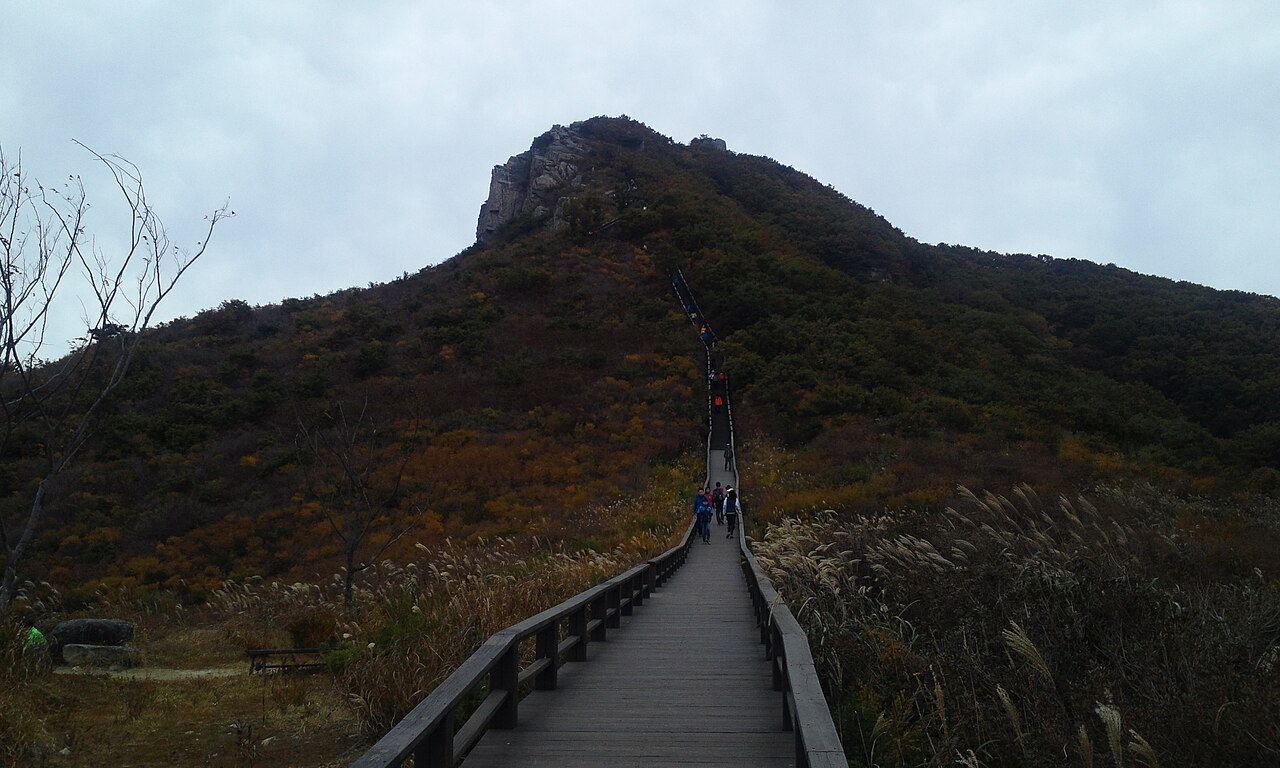
Why visit
The car park at Hwangmae-Pyeongwon plateau sits at about 900 m, which means you can drive most of the way up and be walking through a sea of pink azalea blooms within 20 minutes of getting out of the car. Peak bloom is typically May 18–30. The annual Royal Azalea Festival runs at the same time, and on peak weekends the road in is genuinely congested, but the plateau is wide enough that crowds spread out and it never feels cramped. Come on a weekday morning if you can.
Sunset photography is a consistent draw throughout the year. The treeless open ridgeline at 1,000 m gives an unobstructed western horizon — golden hour on the slope silhouette, with or without azaleas, produces the kind of light that explains why landscape photographers keep coming back. Late May just before or after peak bloom, and mid-October autumn colour, are both exceptional for this.
The plateau was used as a film set for the 2015 historical film The Throne (사도) and for several historical Korean dramas. The landscape reads cinematic — wide sky, open grass ridge, rock outcrops — in a way that makes sense once you know it.
Getting there
Hapcheon has no KTX station. From Seoul the most practical route is KTX to Daegu Dongdaegu Station (about 1 hour 40 minutes, around ₩46,000), then an intercity bus from Dongdaegu Bus Terminal to Hapcheon (about 1 hour, ₩8,000–9,000). From Hapcheon Bus Terminal, a taxi to the lower mountain entrance runs about ₩15,000–20,000. Local buses to the mountain exist but run infrequently — confirm the schedule on Naver Map or Kakao Map before going. From the south, Jinju (served by KTX) also has buses to Hapcheon. A rental car from Daegu is the most flexible option outside the azalea festival period. During the festival, paid shuttle services sometimes operate from Hapcheon town — check Hapcheon county tourism notices in advance.
At a glance
Elevation: 1,108 m Difficulty: 2 / 5 — gentle; vehicle access to about 900 m plateau Typical duration: 2–4 hours depending on how far along the summit ridge you walk Best season: Late May (azalea peak, typically May 18–30); October (autumn colour); any clear evening for sunset Park status: Hwangmaesan County Park (황매산군립공원) — not a national park Entry fee: Around ₩2,000 adults (confirm at gate)
Safety
During the Royal Azalea Festival (typically mid to late May), the access road to the plateau gets severely congested on weekends. Shuttle buses operate from lower parking areas. Follow signage and allow extra time. Arriving before 08:00 or after 16:00 cuts the wait significantly.
The upper plateau and summit ridge have no tree cover. In high wind or sudden storms the exposed terrain becomes uncomfortable fast. Check the forecast and bring a wind layer regardless of season.
Snakes have been recorded in Gyeongnam mountain areas. Stay on marked trails in summer.
Cell signal is generally good across the main trail and plateau. Deeper ravine approaches can be patchy. Download Naver Map or Kakao Map offline before visiting.
Emergency: 119. Korea Tourism hotline 1330 (English available).
Map
Food on the trail
During the azalea festival, a temporary food market sets up on the plateau with vendors selling tteokbokki (떡볶이), grilled corn, hotteok, and packaged snacks. Expect long queues at peak times; prices are festival-market level, around ₩3,000–8,000 per item.
Small restaurants near the lower car parks serve standard Korean mountain fare — doenjang jjigae (된장찌개), bibimbap (비빔밥), pajeon (파전), makgeolli (막걸리). Most open around 08:00 and close by early evening.
Outside the festival season, food options thin out significantly. Bring your own snacks and at least 1 L of water per person.
Hapcheon town is about 20–30 minutes by car with GS25 and CU branches. The Hapcheon traditional market runs on days ending in 3 and 8.
Packing tips
Wind layer — the open plateau channels strong gusts year-round; essential even on warm days. Sun protection — no shade on the upper ridge; sunscreen, hat, and UV sleeves strongly recommended for the azalea season and summer. Cash — entry fee (around ₩2,000) and festival vendors typically cash only. Snacks and water — no vendors on the plateau outside the festival period; bring at least 1 L per person. Camera or charged phone — azalea bloom, sunset silhouettes, and autumn colour are among the most photographed scenes in Gyeongnam.
Best season
Late May: Azalea peak is typically May 18–30. The treeless plateau turns solid pink and the festival runs concurrently. Come on a weekday if possible — weekend road congestion is serious. Early May before peak bloom and early June just after, at golden hour, are also exceptional for photography.
June–August: The plateau turns deep green and crowds disappear almost entirely. Pleasant for evening walks and sunset watching. July and August afternoon thunderstorms are possible — check forecasts.
October: Autumn colour peaks mid to late October. The open ridge with red and orange scrub against a wide sky is a strong season for photography and far less crowded than spring.
December–February: Snow occasionally transforms the plateau into a monochrome landscape. No closures. The ridge is cold and exposed — wind chill can be severe, so dress for it.
Culture & history
Hwangmaesan (黃梅山) takes its name from an old observation that the hillside azalea blooms in early morning light resembled the yellow plum blossoms (황매화) of Chinese classical poetry — a poetic reach, given that the flowers are botanically royal azalea (철쭉), but the name stuck.
The mountain is in Hapcheon County, which is also home to Haeinsa (해인사) on nearby Gayasan — one of Korea's Three Jewel Temples and the home of the Tripitaka Koreana (팔만대장경), the world's most complete surviving Buddhist scripture collection on wood blocks, carved in the 13th century. Hwangmaesan and Haeinsa are pairable in a single Gyeongnam trip; the combination of flower mountain and one of Korea's most significant religious sites makes for an unusually complete day or two.
The sweep of the open grass-and-flower plateau has made Hwangmaesan a consistent film location. The landscape was used to represent ancient Korean palace grounds and battlefields in historical dramas and films including The Throne (사도, 2015). Its seasonal transformation — winter snow, May pink, October gold — keeps it recurring in Korean landscape photography and poetry as a shorthand for the Gyeongnam highlands.
Frequently asked questions
›How high is Hwangmaesan?
Hwangmaesan rises to 1108 m above sea level.
›How difficult is hiking Hwangmaesan?
The difficulty of Hwangmaesan is rated 2/5 (Easy). Difficulty varies by trail, so check each course before you go.
›When is the best season to hike Hwangmaesan?
The best time to hike Hwangmaesan is Spring.
Have more questions? Ask the community on Connect Korea →