
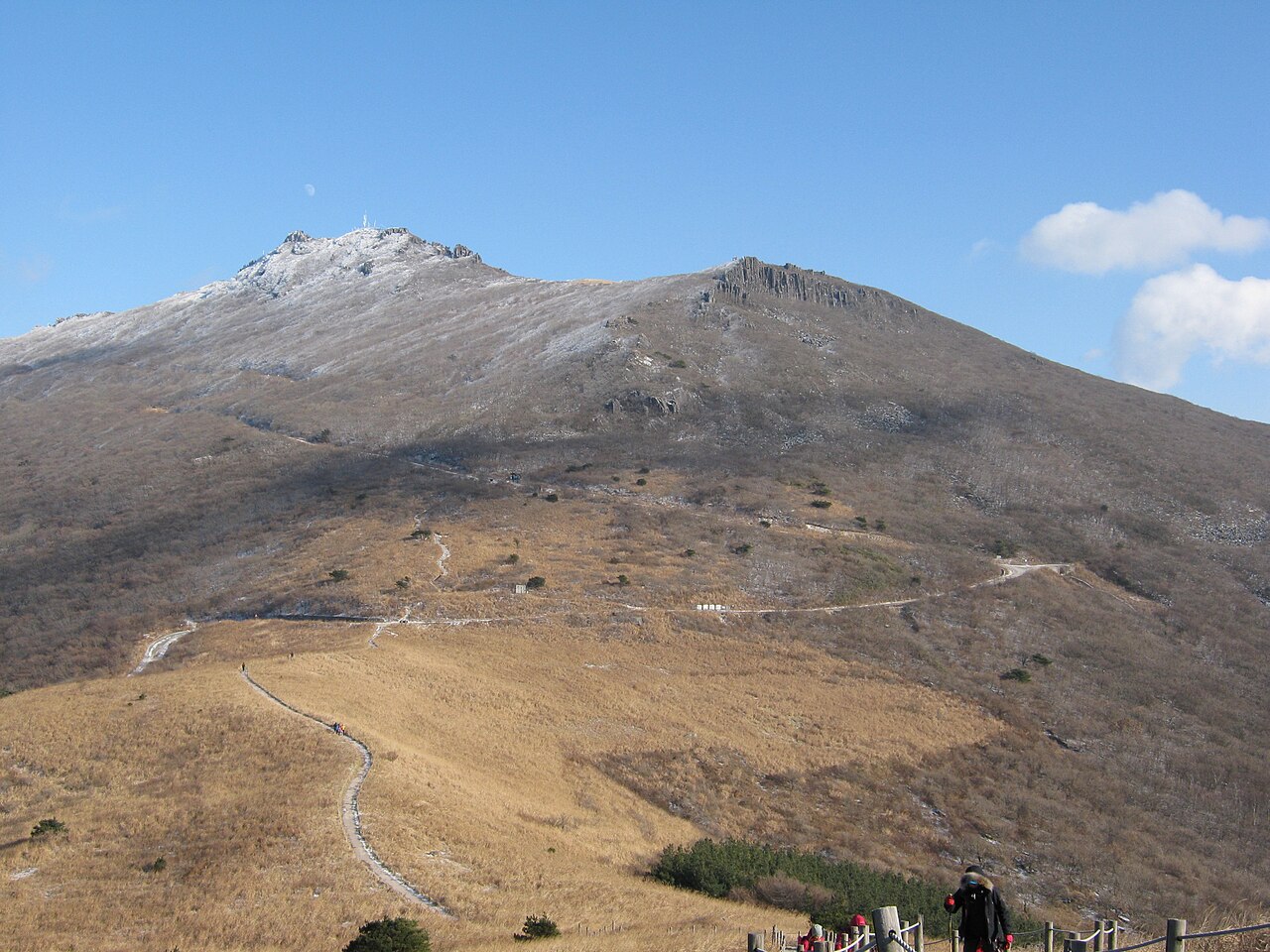
Why visit
The columnar-joint formations are the real draw and they genuinely look unlike anything else in Korea. Ipseokdae and Seoseokdae are clusters of hexagonal stone pillars 5–10 m tall that formed when volcanic rock cooled slowly around 70 million years ago. They are a UNESCO Global Geopark site and Natural Monument No. 465. Walking up to them from the Jeungsim-sa trailhead takes about two hours, and the approach through forest makes the sudden appearance of the pillars hit harder.
The food at the trailhead is worth planning around. The restaurants at the Jeungsim-sa entrance have been serving boribap (보리밥) — barley rice with mountain vegetable side dishes and doenjang — since before most of the current hikers were born. Cold makgeolli and a crispy pajeon alongside it is the correct post-hike order. These places are standing-room-only on weekend mornings; go before 09:00 or after 13:00.
Mudeungsan is also where 1980 matters. The mountain sheltered people during the Gwangju Uprising and has been a place of memory ever since. Poets and painters retreated here for centuries before that. The Joseon-era pavilions on the western slopes — Songgangjeong, Sigyeongjeong — are connected to the poet Jeong Cheol and are a ten-minute detour from the main trail network. Most hikers walk past them without knowing what they are, which is a shame.
Getting there
Mudeungsan is inside Gwangju city, which makes access easier than almost any other national park mountain in Korea. KTX from Seoul Yongsan or Seoul Station reaches Gwangju Songjeong Station (광주송정역) in about 1 hour 40 minutes. From there, take subway Line 1 three stops east to Geumnamno 4-ga (금남로4가역), then bus 27 or 1187 to the Jeungsim-sa (증심사) trailhead — total from the KTX station around 40 minutes, fare about ₩1,500. A taxi from Gwangju Songjeong to Jeungsim-sa costs ₩15,000–20,000 and takes 25–30 minutes. For the Wonhyo-sa (원효사) trailhead on the northwest side, bus 1000 runs from Gwangju Bus Terminal. Use KakaoMap for live departure times.
At a glance
Elevation: 1,187 m (Cheonwangbong — Air Force restricted; public top is Seoseokdae at 1,100 m) Difficulty: 3 / 5 Typical duration: 4–6 hours round trip from Jeungsim-sa trailhead Best season: April (azaleas on Seoinbong ridge), October (autumn colour), January–February (rime ice on pillars) National park: Mudeungsan National Park — designated 2012 Entry fee: Free (as of 2024; confirm at gate)
Safety
The actual summit Cheonwangbong (1,187 m) is inside an Air Force radar installation and off-limits to the public. The accessible high point is Seoseokdae (서석대, 1,100 m). Trails to Inwangbong and Jiwangbong were reopened in 2011 after a 45-year closure — confirm current status at the park office or via 1330 (Korea Tourism hotline, English available) before your visit.
Seasonal fire-prevention closures apply to some trails in spring (roughly February–April) and autumn. Check the KNPS Mudeungsan site or call 1330 the day before.
Cell signal is generally good on the main trails given the proximity to Gwangju, though the Gyubongam (규봉암) side valleys have dead zones. Download offline maps before going.
For emergencies dial 119 (mountain rescue, English relay available). Ranger posts are at both the Jeungsim-sa and Wonhyo-sa entrances.
Map
Food on the trail
The boribap (보리밥) restaurants at the Jeungsim-sa entrance are the thing. Barley rice mixed with doenjang and five or six mountain vegetable side dishes — gosari (고사리 bracken), doraji (도라지 bellflower root), spinach — costs about ₩9,000–12,000 a bowl. The places here are well-worn and not fancy, which is entirely correct. Pair it with cold draft makgeolli and pajeon. Busy every weekend morning; go before 09:00 or you will queue.
A small kiosk near the Jeungsim-sa temple gate sells bottled drinks and packaged snacks. There is nothing to buy on the upper mountain, so sort out supplies at the trailhead. For pre-made convenience food, GS25 and CU branches are available in eastern Gwangju about 10–20 minutes by bus. Cash preferred at the trailhead restaurants; the kiosk is cash-only.
Packing tips
Micro-spikes or strap crampons (December–February) — the upper trail to Seoseokdae ices over after overnight freezes; micro-spikes handle most winter days. Water 2 L minimum — no water sources above the trailhead; the kiosk near Jeungsim-sa gate is the last resupply point. Trekking poles — the descent from Ipseokdae has steep rocky sections; poles help the knees. Camera or small tripod (winter) — dawn rime ice on the columnar pillars is a serious photography target; the formations start eroding by mid-morning. Cash — trailhead boribap restaurants and the Jeungsim-sa kiosk often do not take card.
Best season
April: Azaleas on the Seoinbong ridge peak around April 15–25. Cherry blossoms near Jeungsim-sa arrive earlier, late March. Spring weekends fill up; start before 08:30.
June–August: Hot and humid in the valleys but the forested lower trail stays bearable. Go early. The falls along the valley trail run well after July monsoon rain.
October–November: The best all-round time. Maple colour peaks around October 20–30 and the combination of autumn leaves against grey stone pillars at Seoseokdae is genuinely good. Expect crowds on October weekends.
January–February: The photographer's season. Rime ice coats the hexagonal columns at Ipseokdae and Seoseokdae on cold clear mornings, turning them white. Gentler conditions than higher-altitude peaks like Seoraksan, but crampons are still advisable after overnight freezes.
Culture & history
The name 無等山 — "mountain with no equal" — is not modesty; it reflects a genuine conviction held in Gwangju for over a thousand years that this mountain is singular. The geological strangeness of the columnar-joint formations has something to do with it. The columns were not understood scientifically until the 20th century, and local tradition had its own explanations involving heaven and stone.
Jeungsim-sa (증심사) and Wonhyo-sa (원효사) are both attributed to the Silla monk Uisang in the 7th century. Jeungsim-sa's five-storey stone pagoda is a national treasure. The temples are still active monasteries; they are not museums.
The Joseon poet Jeong Cheol (정철, 1536–1593) wrote the gasa poem Seonsan Byeolgok while living near this mountain. The pavilions he referenced — Songgangjeong, Sigyeongjeong, Myeonangjeong — are still standing on the western slopes and accessible from the trail network. Most visitors do not know this and walk straight past them.
Mudeungsan also carries the weight of 1980. The Gwangju Uprising is inseparable from Gwangju's identity, and the mountain played a real role as a place of refuge and mourning. That history is present when you are in this city even if it is not spelled out on a trail sign.
Frequently asked questions
›How high is Mudeungsan?
Mudeungsan rises to 1187 m above sea level.
›How difficult is hiking Mudeungsan?
The difficulty of Mudeungsan is rated 3/5 (Moderate). Difficulty varies by trail, so check each course before you go.
›Do I need a reservation to hike Mudeungsan?
No reservation is needed for the main trails on Mudeungsan. Just check trail conditions before you set out.
›When is the best season to hike Mudeungsan?
The best time to hike Mudeungsan is Fall.
Have more questions? Ask the community on Connect Korea →