
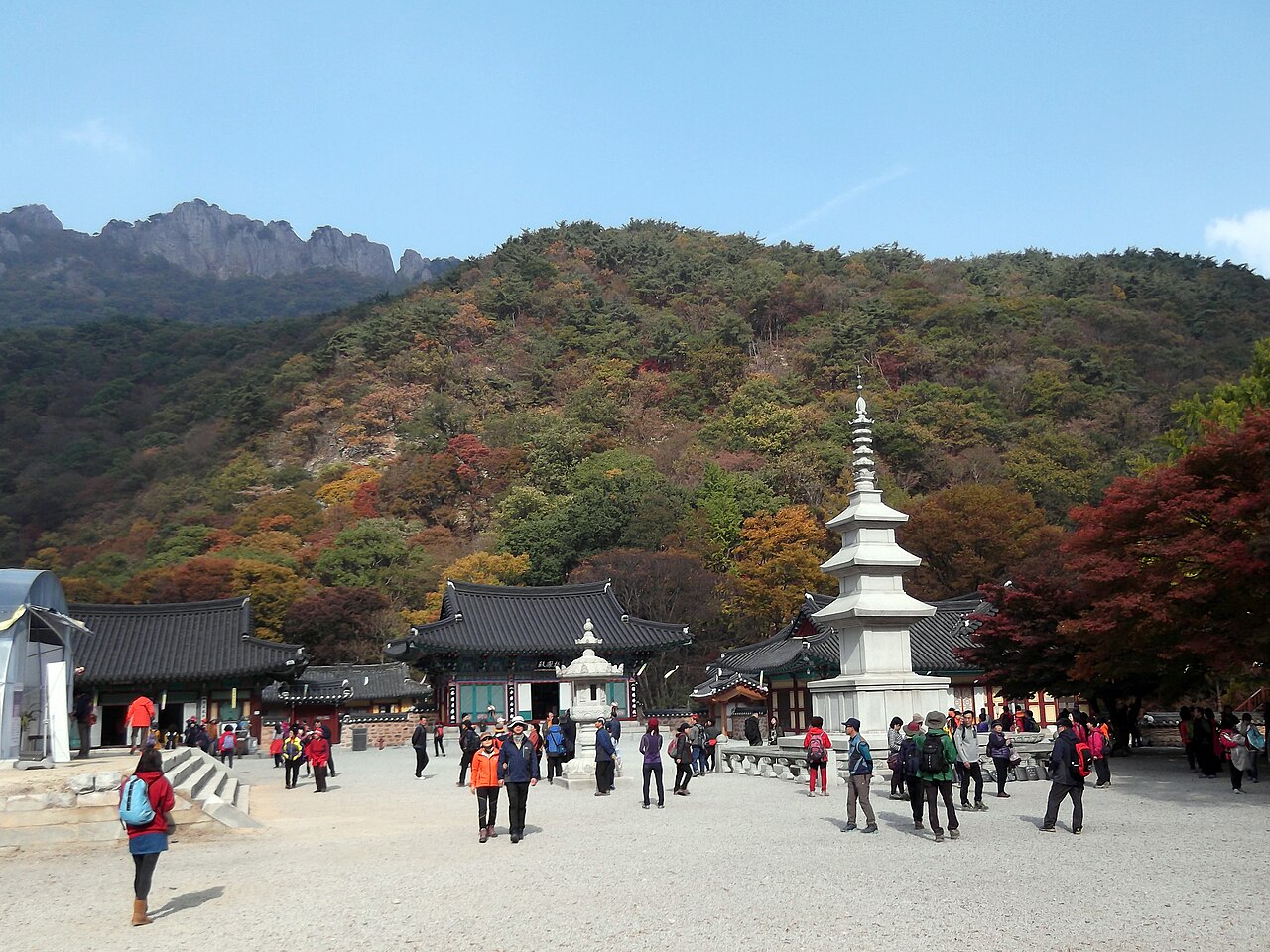
Why visit
The autumn foliage is in a different category from any other mountain in Korea. Naejangsan's combination of a single narrow valley with very high density maple planting, combined with a south-facing orientation that prolongs colour duration, produces results that simply are not replicable elsewhere. Late October through early November is the window. The colour peak is tracked obsessively on Korean hiking forums and news, and for good reason.
The Naejangsa temple (내장사) sits at the valley head and the approach tunnel of maples between the park entrance and the temple is about 700 m long. Peak colour here means you are walking through a complete overhead canopy of red, orange, and yellow. The cable car (케이블카) to the ridge provides an aerial view of the colour canopy for those who prefer it, or a quick way up to the higher viewpoints.
For hikers, the crater-like ridge circuit above the valley — the Naejang-bong (내장봉) to Seoraebong (서래봉) traverse — gives a good 3–4 hour loop above the tree-line with views down into the coloured valley. Outside of autumn, the mountain is pleasant but comparatively quiet.
Getting there
From Seoul Express Bus Terminal (서울고속버스터미널), take an express bus to Jeongeup (정읍) — about 2 hours 30 minutes. From Jeongeup bus terminal, take local bus 171 or 171-1 to Naejangsan National Park (내장산국립공원) — about 30 minutes.
Alternatively, KTX or SRT to Jeongeup Station (정읍역) and then taxi or bus to the park entrance.
During the autumn foliage peak (late October), shuttle buses from Jeongeup station to the park often run on weekends — check current year schedules. Taxi from Jeongeup station to the park entrance is about ₩10,000–13,000.
At a glance
Elevation: 763 m (Sinseondae summit) Difficulty: 2–3 / 5 Typical duration: 3–4 hours for the ridge circuit; 1 hour to Naejangsa temple from entrance Best season: Late October–early November (peak foliage); cable car available year-round National park: Naejangsan National Park (내장산국립공원) Entry fee: ₩3,000 adults Nearest city: Jeongeup (정읍)
Safety
Peak season crowd management: Late October weekends at Naejangsan are among the most crowded days at any Korean national park. Arrive very early (before 08:00) or on a weekday. Parking fills by 07:30 on peak weekends. Shuttle buses from Jeongeup operate to manage traffic.
Cable car: The cable car is popular but has long queues on peak autumn weekends — wait times can exceed 2 hours. Hiking up is often faster.
Trail closures: Standard KNPS fire-prevention schedule. Confirm at knps.or.kr.
Ridge circuit trails: Some sections are steep and exposed. Slippery in wet conditions. Not technical but care needed.
Emergency: 119.
Map
Food on the trail
Park entrance commercial area: A substantial cluster of restaurants and food stalls near the main gate. Local specialties include naejangsan goguma (고구마, sweet potato dishes), makgeolli (막걸리, rice wine) paired with pajeon (파전, spring onion pancake), and sanchae bibimbap. Very lively in autumn.
Jeongeup town: Standard Korean dining options for a pre- or post-hike meal.
On the trail: Stalls near the temple; nothing above. Carry water and snacks for the ridge circuit.
Packing tips
Autumn layers — mornings are cold even when afternoons warm up in late October; the ridge is significantly colder than the valley. Camera or phone with good camera — the foliage is genuinely exceptional and worth the preparation. Water 1.5 L — not a long mountain but the ridge loop in warm autumn sun requires hydration. Light traction aids November onwards — early leaf fall exposes wet roots and slippery stone. Early departure plan — the crowd logistics for peak autumn weekends require aggressive early starts.
Best season
Late October–early November: The entire reason to visit. Colour peak is usually October 25–November 5, though it varies by year. Check Korean news and hiking communities for the current year's forecast. Mid-week visits during the peak avoid the extreme crowds.
April–May: Spring flowering, fresh green. Pleasant and much quieter than autumn. The temple grounds are attractive in early spring.
June–September: Green and cool in the valley. Less photographed but perfectly pleasant hiking.
December–March: Quiet and cold. The ridge walk is fine with appropriate gear but the main draw (foliage) is absent.
Culture & history
Naejangsan's name (內藏山) means "mountain that hides ten thousand things inside" — a reference to the extraordinary natural abundance of the valley: dense forest, varied wildlife, dozens of plant species, and the sense of a world enclosed within the crater-like ridge. The name captures something real about the experience of entering the valley.
Baegam Hot Springs nearby were mentioned in Joseon-era records. Naejangsa Temple (내장사) within the park traces its origins to 636 CE. The temple was burned during the Korean War and rebuilt; its main hall was burned again in 2021 in an arson incident and is currently under restoration.
The maple trees that make Naejangsan famous are predominantly danpung (단풍나무, Acer palmatum) and various related species planted deliberately over centuries along the valley approach. The concentration and density of maple planting reflects both natural conditions and deliberate cultivation — the famous tunnel effect near the temple entrance is partially the result of managed tree growth over generations. Korea's autumn (가을, gaeul) culture is closely tied to mountains, and Naejangsan is the cultural benchmark for the season.
Frequently asked questions
›How high is Naejangsan?
Naejangsan rises to 763 m above sea level.
›How difficult is hiking Naejangsan?
The difficulty of Naejangsan is rated 3/5 (Moderate). Difficulty varies by trail, so check each course before you go.
›Do I need a reservation to hike Naejangsan?
No reservation is needed for the main trails on Naejangsan. Just check trail conditions before you set out.
›When is the best season to hike Naejangsan?
The best time to hike Naejangsan is Fall.
Have more questions? Ask the community on Connect Korea →