
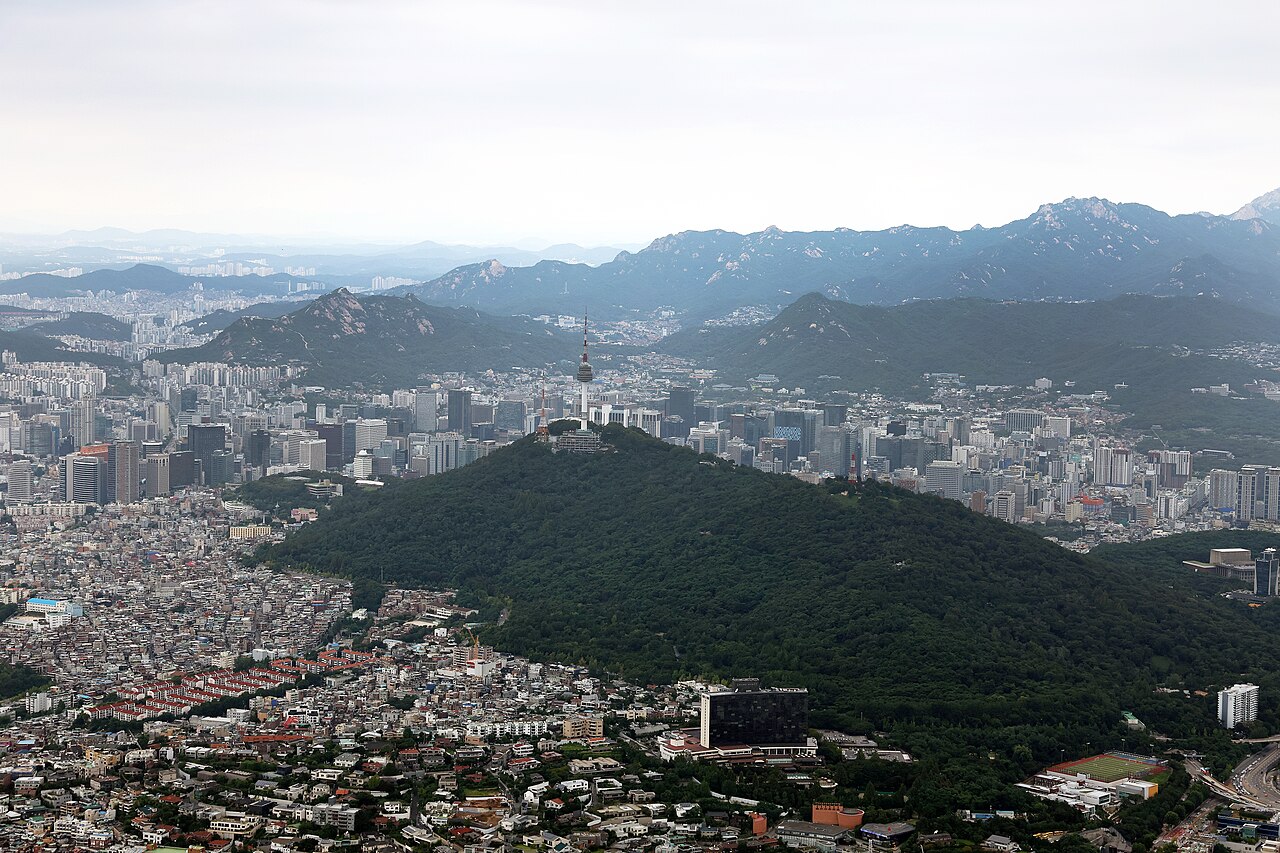
Why visit
Namsan is genuinely accessible to everyone — young children, elderly visitors, people with mobility limitations — which makes it the right first Seoul mountain for many travellers. The walk from Myeong-dong takes 45 minutes on a paved path. The cable car takes 3 minutes. Neither requires hiking boots.
The N Seoul Tower observation deck sits at 480 m above sea level (peak elevation plus tower height), putting Bukhansan's granite domes, the Han River bends, and on clear days the Incheon coast in the same frame. Night visits between 9 pm and midnight give the sharpest cityscape views — the tower is lit in seasonal colours and the Han River bridges glow below.
The five Bonghwadae signal-fire beacons on the summit ridge were the final terminus of Korea's pre-modern national communication network — relay fires that could transmit alerts from the country's borders to this hilltop in hours. They are still lit ceremonially on national holidays. The Hanyangdoseong fortress wall sections accessible from the summit provide a physical connection to the city's 600-year founding.
The walk down through Itaewon (south approach) gives a different Seoul than Myeong-dong — Korea's most international street, with halal restaurants, independent bars, and one of the city's best antique markets. The mountain connects two very different neighbourhoods and a single hike can sample both.
Getting there
Walk from Myeong-dong: Line 4, Myeong-dong Station exit 3. Follow signs uphill through Namsan Park — paved path, about 45 minutes to the tower plaza. This is the most popular foreigner route and is straightforward.
Cable car: Line 4 to Hoehyeon Station (회현역, exit 4), walk 10 minutes to the lower cable car station. Round trip ₩14,000 adults. Weekend queues exceed 30 minutes at peak hours — arrive before 10:00 or after 17:00.
Circular buses: yellow Namsan buses 02, 03, 05 depart from Chungmuro Station (Lines 3 & 4) and Itaewon Station (Line 6). ₩1,200 with T-money. Runs every 15–20 minutes, last departures around 23:00.
Itaewon approach: Line 6 exit 2 — a tree-lined 40-minute walk arriving from the south. Quieter than the Myeong-dong route.
At a glance
| Detail | Info |
|---|---|
| Elevation | 265 m peak; 480 m above sea level to N Seoul Tower deck |
| Difficulty | 1 / 5 — paved paths, suitable for all ages |
| Typical duration | 30 min (cable car) – 90 min (walk up from Myeong-dong, down via Itaewon) |
| Best season | Year-round; night views Oct–Feb exceptional |
| National park | No — Seoul city park (Namsan Park) |
| Entry fee | Free (park); tower observation deck ₩21,000 adults |
| Nearest subway | Myeong-dong (Line 4) · Hoehyeon (Line 4) · Itaewon (Line 6) |
Safety
Emergency: 119. English: 1330 (24 hours).
Winter paths: despite being paved, Namsan's walkways ice over December through February. The city applies sand and de-icer but the steeper Myeong-dong stairway sections remain slippery. Grippy shoes; avoid smooth soles or sandals.
Crowds: weekends and public holidays bring large crowds around the tower and cable car. Keep valuables secure.
Night safety: the park is well-lit and patrolled until well after midnight. Generally safe for solo visitors on main paths. Stay on lit paths after dark.
Wildlife: raccoon dogs (너구리) appear at dusk occasionally. Do not feed them.
Cell signal: full LTE/5G across the entire park.
Map
Food on the trail
Myeong-dong below the north face is Seoul's most foreigner-friendly food zone. Street vendors sell 핫도그 (corn dogs), 떡볶이 (spicy rice cakes), and 토네이도 감자 (tornado potato). CU, GS25, and 7-Eleven are everywhere for kimbap and drinks.
Tower plaza: a café (operators rotate) near the tower entrance serves standard Korean café drinks at ₩5,000–8,000. The tower's rotating restaurant is substantially pricier.
Itaewon (south approach exit): halal restaurants, Indian, Mexican, and vegan options all within 5 minutes of the trail end — more international variety than any other Seoul mountain approach.
On the mountain: no food sold on the trails themselves. Carry water; the walk is short enough that snacks are optional.
Packing tips
Namsan needs almost nothing:
- Comfortable walking shoes — any season except smooth-soled in winter
- A light layer for the tower observation deck (air-conditioned even in summer)
- Padlock if you want to participate in the love-lock tradition (₩3,000–5,000 at nearby vending machines)
- Phone with night mode — the evening cityscape is the main photographic draw
No hiking gear, poles, or specialist footwear required.
Best season
Spring (Mar–May): Cherry blossoms on the lower slopes in late March — among Seoul's best spots for blossom viewing. Mild temperatures and clear skies.
Summer (Jun–Aug): Hazy conditions reduce tower views. Evening visits after 19:00 are pleasanter and less crowded than midday.
Autumn (Oct–Nov): The tower lit against autumn colours with sharp air visibility is the most photogenic version of Namsan. Maple and ginkgo peak in late October.
Winter (Dec–Feb): Night visits 22:00–midnight offer the sharpest cityscape of the year with the fewest crowds. Snow on the slopes with the glowing tower is a classic Seoul winter image. Icy paths — wear grippy shoes.
Culture & history
Namsan (南山, "South Mountain") has been Seoul's symbolic southern guardian since Joseon King Taejo sited Hanyang in 1394. The capital's geomantic design placed four mountains at the cardinal points — Bugaksan north, Naksan east, Inwangsan west, Namsan south — each one protecting the city's directional energy.
The five Bonghwadae (봉화대) beacons on the summit were the southern terminus of Korea's national signal-fire relay system. One fire burning meant peace. Two fires meant an enemy had appeared on the border. Five fires — simultaneous across all five platforms — meant full invasion. The system linked every provincial post in Korea to this hilltop. Restored beacons are ceremonially lit on Independence Movement Day (March 1) and other national holidays.
The Hanyangdoseong (한양도성) wall, begun in 1396, winds across Namsan's slopes for several kilometres and is walkable today. Some original stones from the early Joseon construction remain embedded among later repairs — you can distinguish them by the larger, rougher cutting.
N Seoul Tower, opened in 1980 as a broadcast transmission facility, became a cultural fixture through K-drama appearances from the 1990s onward. The love-lock tradition — couples attaching padlocks to the fence below the observation deck — is a recent addition (popularised in the 2000s) that has added an entirely new layer of meaning to the mountain's social life.
Frequently asked questions
›How high is Namsan Seoul?
Namsan Seoul rises to 265 m above sea level.
›How difficult is hiking Namsan Seoul?
The difficulty of Namsan Seoul is rated 1/5 (Very easy). Difficulty varies by trail, so check each course before you go.
›When is the best season to hike Namsan Seoul?
The best time to hike Namsan Seoul is Fall, Spring.
Have more questions? Ask the community on Connect Korea →