
Why visit
The fir tree avenue at Woljeongsa is the single most photographed approach to any temple in Korea's national parks. About 1 km of massive Korean fir trees (전나무) line the stone path to the temple gate — the canopy is thick enough that light filters through in shafts on clear mornings, and in snowfall the effect is extraordinary. The temple itself, founded in 643 CE by the monk Jajang, houses an intact nine-tier octagonal stone pagoda (국보 제48호) in its courtyard.
Odaesan is the only mountain in Korea structured around five directional Buddhist meditation summits — Dongdae (동대), Seodae (서대), Namdae (남대), Bukdae (북대), and Jungdae (중대) — each with its own hermitage. This arrangement dates to the Silla period and represents a living religious geography. Most hikers only visit one or two, but the concept gives the entire mountain a coherence that purely scenic peaks lack.
Woljeongsa runs one of the most foreigner-accessible templestay programs in Korea, with English-speaking guides and overnight programs that include meditation, chanting, and morning ritual participation. For anyone wanting a genuine introduction to Korean Buddhist practice rather than a tourist briefing, this is the practical choice.
Getting there
From Seoul Dong-Seoul Bus Terminal (동서울터미널, Gangbyeon Station, Line 2), take an intercity bus to Jinbu (진부) — about 2 hours, buses roughly hourly, fares around ₩14,000–16,000. From Jinbu terminal, local bus 306 runs to Woljeongsa (월정사) in about 25 minutes.
Alternatively, take the KTX or ITX-Cheongchun train to Jinbu Station (진부역, opened 2017 for the Pyeongchang Olympics) and then bus or taxi to the temple. The train is faster from Seoul but the schedule is more limited.
From Woljeongsa to Sangwonsa (상원사), further up the valley, there is a shuttle bus or a pleasant 9 km forest road walk — most hikers take the bus up and walk down.
Taxi from Jinbu to Woljeongsa costs approximately ₩15,000–18,000 and takes about 20 minutes.
At a glance
Elevation: 1,563 m (Birobong summit) Difficulty: 4 / 5 — long ridge traverse; Woljeongsa forest walk is easy (1 / 5) Typical duration: 5–7 hours round trip from Sangwonsa to Birobong; Woljeongsa walk 30 min one-way Best season: May–June (fresh green), October (foliage), January–February (snow + Nordic ski) National park: Odaesan National Park (오대산국립공원) Entry fee: ₩3,500 adults (confirm at gate) Nearest transport: Bus from Jinbu terminal; KTX to Jinbu Station
Safety
Trail closures: National park fire-prevention closures typically run May 1–15 and November 1–December 15 on summit trails. Check the KNPS website (knps.or.kr) or call 1330 (24 hours, English available) the day before.
Bears: Asiatic black bears (반달가슴곰) live in the park. Make noise on trail, keep food sealed, and do not approach wildlife. Incidents are rare.
Cell signal: Good near Woljeongsa and Sangwonsa. Gaps between the five plateau hermitages and on the upper ridge approach. Download offline maps before leaving the valley.
Weather: Odaesan is significantly colder and snowier than Seoul mountains. The park can receive 2–3 m of snow in winter. Check forecasts and be prepared for rapid weather changes on the upper ridge.
Emergency: 119. Note trail marker numbers along the route — useful when reporting your position.
Map
Food on the trail
Woljeongsa temple area: Several restaurants near the temple entrance serve mountain-style Korean food — dotorimuk (도토리묵, acorn jelly), sanchae bibimbap (산채비빔밥, mountain vegetable bibimbap), and mushroom dishes using ingredients from the local forest. These are a step above typical trailhead restaurants and worth sitting down for.
Jinbu town: More conventional options — gukbap (국밥), Korean BBQ, and convenience stores. If you are catching a morning bus, grab breakfast here before the park.
On the mountain: No food stalls above the Woljeongsa commercial area. The Sangwonsa rest area has a small snack kiosk during peak seasons but do not rely on it. Carry your own lunch for any summit attempt.
Packing tips
Warm layers even in summer — Birobong summit is noticeably cooler than the valley; bring a fleece or light down. Rain gear — the forest traps moisture; afternoon rain showers are common May–September. Gaiters in winter — deep snow on the upper trails; gaiters keep boots dry. Crampons October–April — the upper ridge stays icy well into spring. Lunch — no food above the temple area. Offline map — download Naver or KakaoMap route before leaving Jinbu; cell gaps on the upper ridge.
Best season
May–June: New green on the ancient forest, waterfalls running well, cool and clear. The fir avenue at Woljeongsa is at its freshest. Fewer crowds than autumn.
July–August: Lush and humid; the forest canopy keeps things cooler than open mountains. Good for the valley walks; the summit is pleasant in the morning.
October: Peak foliage, typically the second to third week. The Woljeongsa approach in October is the mountain at its most photogenic. Weekends are crowded; mid-week visits are much calmer.
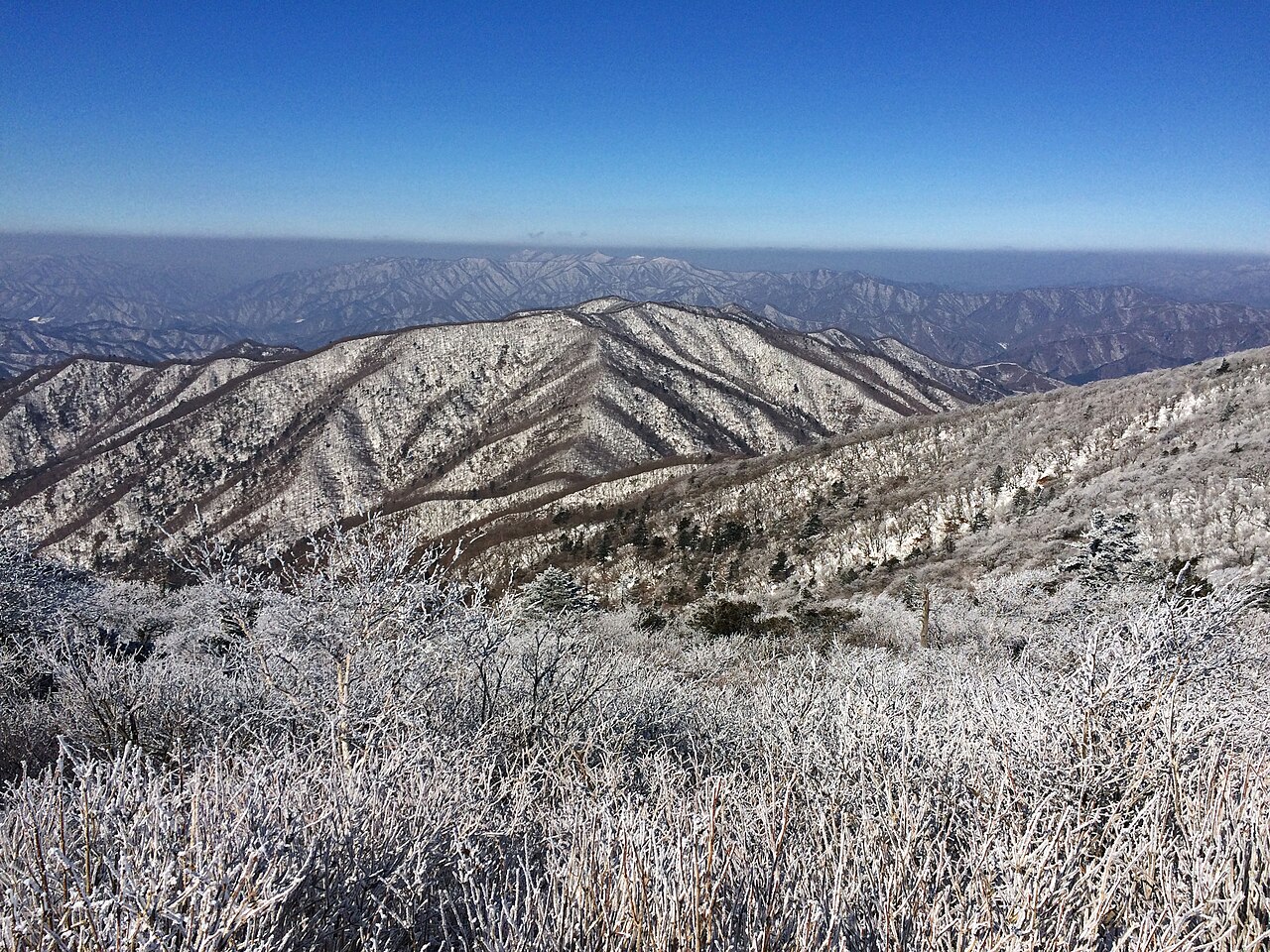
January–February: Heavy snow transforms the fir forest into one of the most striking winter scenes in Korea. Cross-country skiing is available at the Odaesan ski area. Come prepared for genuine cold — temperatures can drop to -15 °C or lower on the upper ridge.
Culture & history
The name Odaesan (五臺山, "Five Plateau Mountain") encodes the mountain's religious geography. The monk Jajang (자장율사), returning from Tang dynasty China in 643 CE, brought Buddhist relics and established Woljeongsa, believing Odaesan to be a Korean manifestation of Mount Wutai (五臺山) — the Chinese sacred mountain associated with Manjushri, the bodhisattva of wisdom. The five directional plateaus were each assigned a directional bodhisattva and a specific practice, creating a complete Buddhist cosmological map in mountain form.
Sangwonsa (상원사), higher up the valley, is believed to contain the oldest extant temple bell in Korea (국보 제36호, cast 725 CE), and a wooden building that survived the Korean War largely intact. The temple is active and considerably quieter than Woljeongsa.
During the Joseon dynasty, Odaesan became a repository for Annals of the Joseon Dynasty (조선왕조실록) — complete copies of Korea's royal chronicles were kept in fireproof archive buildings on the mountain to preserve them from warfare and fire. Copies stored here survived when other archives did not. The tradition of using the mountain as a place of preservation — of relics, texts, and practice — is consistent across 1,400 years of its history.
Frequently asked questions
›How high is Odaesan?
Odaesan rises to 1565 m above sea level.
›How difficult is hiking Odaesan?
The difficulty of Odaesan is rated 4/5 (Hard). Difficulty varies by trail, so check each course before you go.
›Do I need a reservation to hike Odaesan?
No reservation is needed for the main trails on Odaesan. Just check trail conditions before you set out.
›When is the best season to hike Odaesan?
The best time to hike Odaesan is Fall.
Have more questions? Ask the community on Connect Korea →