
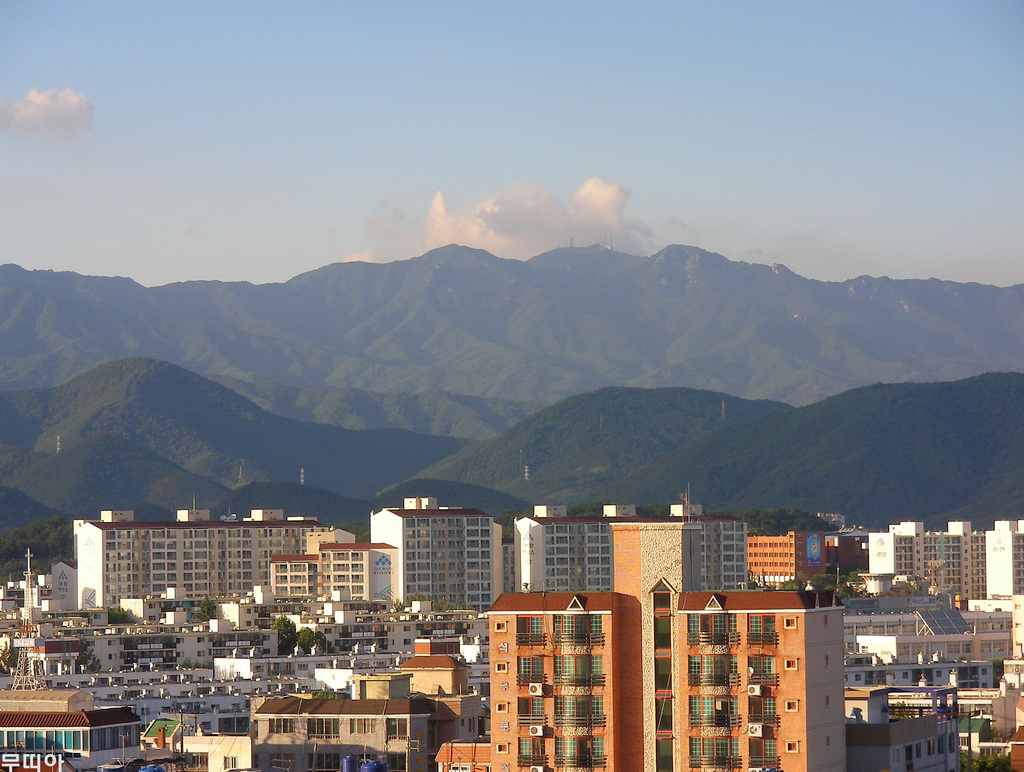
Why visit
Gatbawi is reason enough on its own. The stone Buddha carved into a rock face at 850 m wears a flat stone slab on its head that resembles a traditional gat (갓, a scholar's hat) — unique in all of Korean Buddhist art. The belief that it grants exactly one sincere wish has drawn pilgrims for over a thousand years. Every November, in the days before the national university entrance exam (수능), tens of thousands of Korean parents and students make the 40-minute climb carrying candles and incense. If you want to understand what exam pressure means in this country, stand on that trail at 02:00 in November.
Donghwasa (동화사) is the main temple at the southern base. Founded in 493 CE — Silla dynasty — it houses a 33-metre stone Buddha completed in 1992 for the cause of Korean reunification. The complex is large and genuinely impressive, and the cherry-blossom-lined approach road in late March is one of the best blossom scenes around Daegu.
The mountain also has a cable car that gets you to the Gatbawi ridge without the full climb, which is useful for families and anyone doing a half-day trip from Daegu. The ridge traverse from Dongbong (동봉, 1,167 m — the accessible summit since Birobong is military restricted) across to the Gatbawi side is a solid 5-hour day and worth doing at least once in autumn.
Getting there
Palgongsan is on Daegu's northern edge, and Daegu has a KTX station. From Seoul Station, KTX to Dongdaegu Station (동대구역) takes about 1 hour 40 minutes. From Dongdaegu, bus 급행1 (Express 1) or city bus 101 runs directly to the Donghwasa (동화사) terminal — about 40–50 minutes, ₩1,500. For the cable car station and Gatbawi approach, take Daegu Metro Line 1 to Ayanggyo Station (아양교역) and change to bus 팔공1 — about 35 minutes from there. A taxi from Dongdaegu Station to Donghwasa runs ₩15,000–20,000, about 30 minutes. KakaoMap covers Daegu bus routes well with English interface.
At a glance
Elevation: 1,193 m (Birobong — military restricted; accessible summit is Dongbong at 1,167 m) Difficulty: 3 / 5 Typical duration: 4–6 hours round trip from Suyu-ri trailhead to Dongbong; cable car cuts this significantly Best season: Late March–early April (cherry blossom at Donghwasa), mid-October–early November (autumn foliage + Gatbawi pilgrimage season) National park: Palgongsan National Park — Korea's 23rd, designated December 2023 Entry fee: Free for trails; cable car one-way ₩9,000 / round trip ₩13,000 (confirm current rates)
Safety
Birobong (비로봉, 1,193 m) is inside an active military installation and closed to the public. The accessible high point is Dongbong (동봉, 1,167 m). Respect all fencing near the summit area.
On the night before the 수능 exam (second Thursday of November), the Gatbawi trail becomes very crowded — thousands of people hiking in the dark with candles. If you are there then, use a headlamp, expect slow progress on the narrow final section, and do not rush.
Fire-prevention closures apply to some trails in spring (February–April) and autumn. Check with the park office or call 1330 (Korea Tourism hotline, English available) the day before. Cell signal is good on the main trails and at Gatbawi; weaker in the deep northern and eastern valleys. Pre-download offline maps.
For emergencies dial 119. Staffed ranger posts are near the cable car station and the Donghwasa entrance.
Map
Food on the trail
The main food strip is on the road up to Donghwasa — a dozen or more restaurants doing dak-galbi (닭갈비, spicy stir-fried chicken), sundubu-jjigae (순두부찌개), and samgyeopsal (삼겹살). Portions are generous, prices around ₩10,000–15,000 per person. Avoid the midday rush on weekends; before noon or after 14:00 is easier.
Near the lower cable car terminal there are snack stalls and a cafe — good for coffee before the ascent or ice cream after. Limited hot food.
At the Gatbawi trailhead, a few permanent stalls sell tteok (떡), hotteok (호떡), and canned drinks — busiest around exam season. Nothing available on the ridge itself.
No summit huts or shops anywhere on Palgongsan. Carry 1.5–2 L of water. Daegu is famous for makchang (막창, grilled intestine) and you will see it on menus at the trailhead restaurants — worth trying if you eat offal. Menus are Korean-only; Naver or Papago photo translation works for ordering.
Packing tips
Microspikes or light crampons (December–February) — the Dongbong ridge ices over after cold nights; microspikes handle most days. Water 1.5–2 L — no resupply points above the trailheads; fill up before leaving the car park. Headlamp — essential for the Gatbawi pre-exam-night pilgrimage in November; also useful for early starts in autumn. Cash — trailhead stalls and the cable car ticket office may not accept foreign cards; carry ₩20,000–30,000. Wind layer — Daegu's valleys are warm but the Dongbong ridge gets gusty; a light windshell makes a real difference on the exposed summit approach.
Best season
Late March–early April: Cherry blossoms along the Donghwasa approach road — one of the best temple blossom scenes in the Daegu area. Azaleas follow on the upper ridges in mid-April.
July–August: Daegu is one of Korea's hottest cities in summer. Start before 07:00 on hot days; the forested lower valleys stay cooler.
Mid-October–early November: The best season overall. Autumn colour peaks around October 15–30 and the Gatbawi pilgrimage season overlaps, making this the most atmospheric time to visit. Busy on weekends.
December–February: Snow on the summit ridge looks good and the mountain is quieter. Microspikes recommended after overnight freezes. A reasonable winter day trip from Daegu.
Culture & history
Palgongsan means "Eight Lords Mountain" (八公山) and the name comes from a specific battle. In 927 CE at the Battle of Gongsan, the forces of Goryeo king Wang Geon were ambushed and nearly destroyed by Later Baekje's Gyeon Hwon. Eight generals — including the famous Sin Sung-gyeom — sacrificed themselves to allow Wang Geon to escape. The mountain became a site of mourning and veneration almost immediately, which helps explain why it has accumulated so many temples and shrines over the centuries.
Gatbawi (갓바위) — the wish-granting stone Buddha — was carved in the Unified Silla period, probably the 8th or 9th century. The flat stone "hat" is unique in Korean Buddhist art and nobody fully agrees on what it represents. The pilgrimage tradition, particularly the pre-exam ritual in November, is one of the clearest expressions of how Buddhism, Confucian exam culture, and modern Korean anxiety about education have blended into something entirely local.
Donghwasa (동화사), founded 493 CE, is large enough to spend an hour wandering around without covering everything. The 33-metre Tongil Yaksa Daebul (통일약사여래대불) — completed in 1992 and dedicated to Korean reunification — dominates the car park. Multiple national treasures are in the temple precincts. Pagye-sa (파계사) on the western flank is quieter and was used to store royal Joseon portraits during the Japanese invasions of the 1590s.
Frequently asked questions
›How high is Palgongsan?
Palgongsan rises to 1193 m above sea level.
›How difficult is hiking Palgongsan?
The difficulty of Palgongsan is rated 3/5 (Moderate). Difficulty varies by trail, so check each course before you go.
›Do I need a reservation to hike Palgongsan?
No reservation is needed for the main trails on Palgongsan. Just check trail conditions before you set out.
›When is the best season to hike Palgongsan?
The best time to hike Palgongsan is Fall.
Have more questions? Ask the community on Connect Korea →