
Why visit
The royal azalea (철쭉, cheoljjuk) bloom on Sobaeksan's upper ridge in late May is one of the most documented natural events in Korean hiking culture. The wide, open plateau between Birobong (비로봉, 1,439 m) and Yeonhwabong (연화봉, 1,394 m) turns a deep pink-magenta for roughly two weeks — the visual effect of flower carpets across a windswept bald ridge at 1,400 m is genuinely hard to replicate elsewhere in Korea. Plan well ahead if you want the bloom at peak.
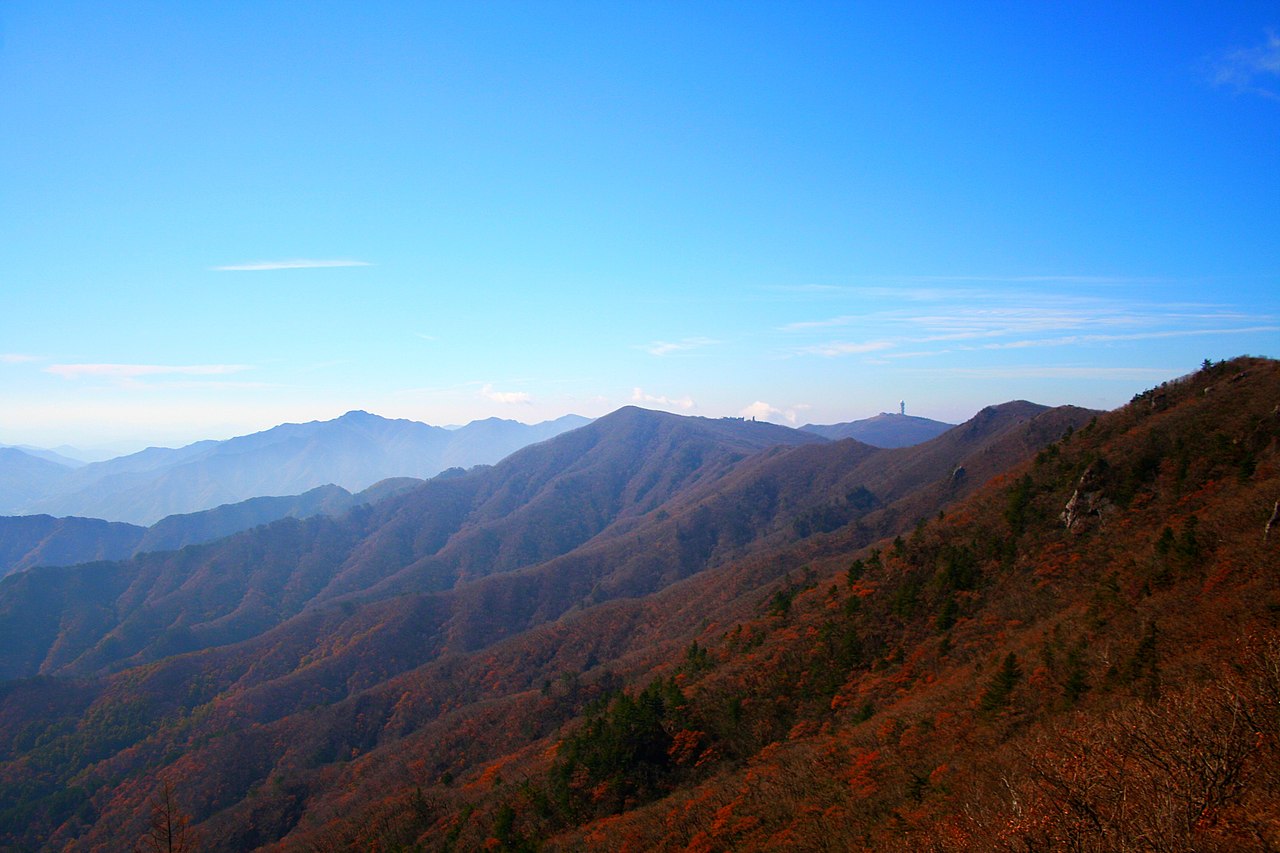
Outside azalea season, the mountain's open ridge offers long-distance views in almost every direction — the entire Sobaek range, Danyang town and its reservoir below, and on clear days the southern plains stretching toward Andong. The upper ridge has a highland meadow feel unusual in Korean national parks, most of which are more heavily forested.
Sobaeksan also has an astronomical observatory (소백산천문대) near the Yeonhwabong summit that is open for public night observation programs — one of the cleaner dark-sky sites accessible from Seoul, useful if you are combining the mountain with a star-gazing visit.
Getting there
From Seoul Cheongnyangni Station (청량리역), take the Jungang Line train to Punggi Station (풍기역) or Danyang Station (단양역) — about 2 hours 30 minutes. From Punggi, local buses or taxis run to the Jugryeong (죽령) trailhead. From Danyang, take buses or taxis to the Cheondonggol (천동골) or Birobong trailheads.
Alternatively, buses from Seoul Dong-Seoul Terminal or Express Bus Terminal go to Danyang or Yeongju — check timetables as services vary by day.
Taxi from Danyang bus terminal to the main trailhead area costs around ₩12,000–18,000 depending on which entrance you choose. The train is generally the most reliable option from Seoul.
At a glance
Elevation: 1,439 m (Birobong summit) Difficulty: 3–4 / 5 Typical duration: 5–7 hours round trip depending on route Best season: Late May (royal azalea bloom); October (foliage); January–February (snow on open ridge) National park: Sobaeksan National Park (소백산국립공원) Entry fee: ₩2,500 adults Nearest cities: Danyang (단양), Yeongju (영주), Punggi (풍기)
Safety
Wind on the open ridge: The upper ridge is fully exposed. Wind speeds are significantly higher here than on forested mountains — cold wind chill in spring and autumn can be severe even when the valley is warm. Always bring a windproof layer regardless of forecast.
Azalea season crowd management: During the late May peak bloom, the trailhead area becomes very crowded. Start before 07:00 to avoid the worst congestion and allow enough time to descend before dark.
Trail closures: Standard KNPS fire-prevention schedule (May 1–15, November 1–December 15). Confirm at knps.or.kr.
Winter: The open ridge accumulates snow and is exposed to wind. Crampons are essential November through March. Check weather — blizzard conditions can make the upper plateau dangerous.
Emergency: 119.
Map
Food on the trail
Danyang town: A small tourist town with good food options — maeum (마음) restaurant strip near the bus terminal. Local specialties include Danyang-style garlic dishes (단양 마늘 요리) and fresh-water fish from the Namhan River. Worth a proper meal before or after the mountain.
Punggi town: Famous for Punggi ginseng (풍기인삼). You can buy ginseng products and eat ginseng-based dishes here.
Trailhead area: Small snack stalls near the main entrances during peak seasons. Do not rely on these — carry your own lunch.
Packing tips
Windproof jacket — essential year-round on the exposed upper ridge. Extra warm layer late May — azalea season can still be cold and windy on the ridge despite warm valleys below. Crampons November–March. Sunscreen and sunglasses — the open plateau reflects UV strongly in winter snow. Lunch and 2 L water — no vendors above the trailhead. Offline map — download before leaving Danyang or Punggi; signal can be unreliable on the upper ridge.
Best season
Late May (typically May 20–June 5): Royal azalea peak. The upper ridge is one of Korea's premier floral spectacles. Check the KNPS website for the current year's predicted bloom dates — they vary by 1–2 weeks depending on spring temperatures. Weekends during peak bloom are extremely crowded; mid-week is strongly recommended.
June–September: Pleasant. The highland meadow feel is distinctive. Summer thunderstorms can develop on the exposed ridge — start early.
October: Foliage season; less famous than the azaleas but the open ridge provides excellent long views through autumn colour.
January–February: Snow on the open ridge; similar highland winter appeal to Taebaeksan but less visited. Good choice for a quieter winter snow experience.
Culture & history
Sobaeksan's name (小白山, "Small White Mountain") is counterpart to Taebaeksan (太白山, "Great White Mountain") to the northeast — both are "white mountains" within the Baekdu-daegan (백두대간), the great ridge system considered the backbone of the Korean peninsula. The mountains of this spine carry a consistent identity in Korean geographic and cultural tradition.
Buseoksa Temple (부석사) on Sobaeksan's western slope is one of Korea's most significant Buddhist heritage sites — a UNESCO World Heritage property (inscribed 2018) and home to the Muryangsujeon Hall (무량수전), one of the oldest surviving wooden buildings in Korea (late Goryeo period). The hall's curved roofline and the view from its steps down over the Sobaek foothills is regularly cited as one of Korea's finest architectural settings. It is worth a separate visit and easily combined with a Sobaeksan hiking day.
The Jugnyeong Pass (죽령, Bamboo Ridge Pass) on the mountain's southern slope is one of the most ancient passes in the Sobaek Range, in documented use since at least the Silla period as a key route between the Yeongnam (Gyeongsang) and Giho (Chungcheong/Gyeonggi) regions. The pass road is still walked today as part of longer trail routes.
Frequently asked questions
›How high is Sobaeksan?
Sobaeksan rises to 1439 m above sea level.
›How difficult is hiking Sobaeksan?
The difficulty of Sobaeksan is rated 3/5 (Moderate). Difficulty varies by trail, so check each course before you go.
›Do I need a reservation to hike Sobaeksan?
No reservation is needed for the main trails on Sobaeksan. Just check trail conditions before you set out.
›When is the best season to hike Sobaeksan?
The best time to hike Sobaeksan is Spring.
Have more questions? Ask the community on Connect Korea →