
Why visit
Beopjusa Temple is a legitimate draw in its own right. The complex houses the Palsangjeon (팔상전), a five-story wooden pagoda and one of the rarest surviving examples of Joseon-era wooden pagoda architecture in Korea. The newly completed 33-metre bronze Maitreya statue (미륵대불) is the largest Buddhist statue in Korea and makes the approach to the temple forecourt an experience with visual scale. The temple received UNESCO World Heritage status in 2018.
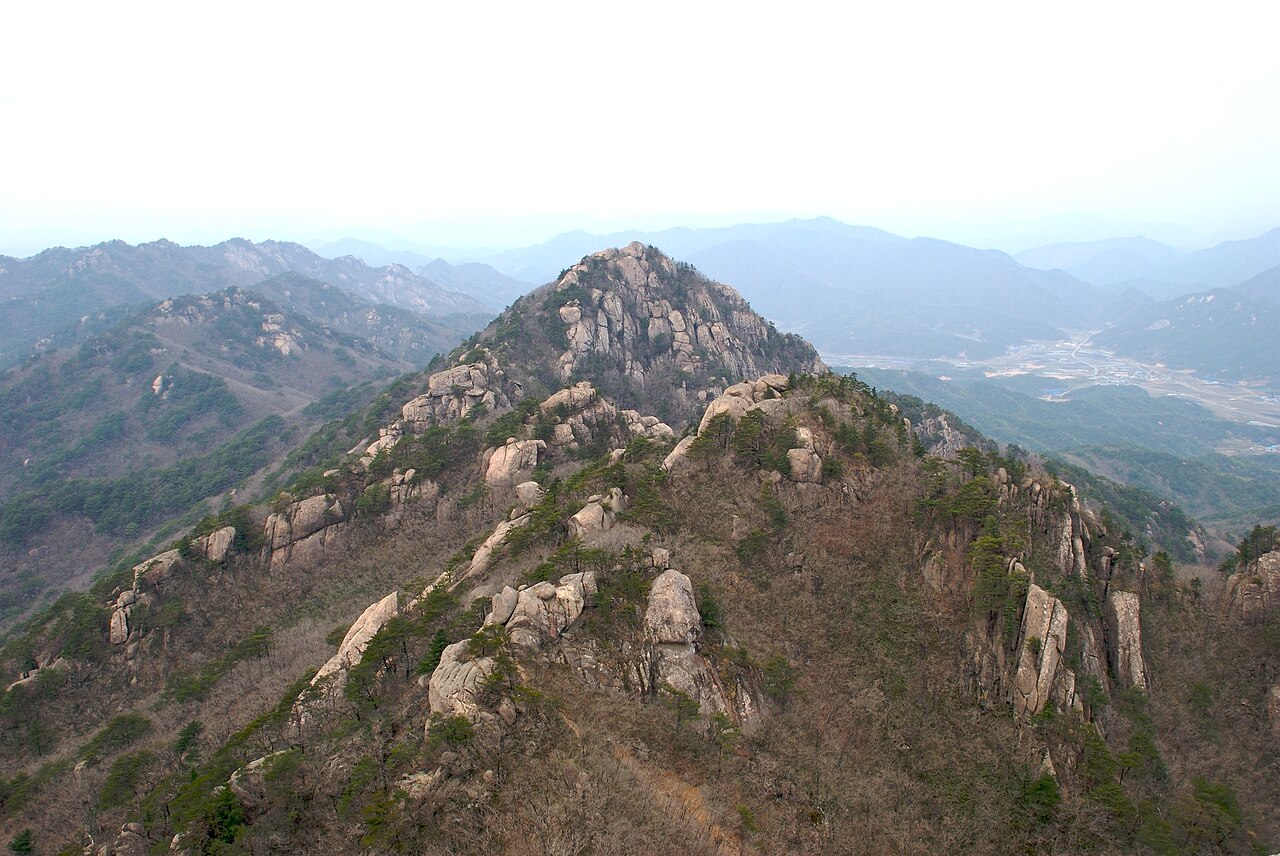
The rocky ridge traverse above the temple — particularly the Cheonwang-bong summit (천왕봉, 1,058 m) and Munjangdae (문장대, 1,033 m) — involves a fair amount of scrambling and offers excellent views across the Charyeong mountain range. The rock formations in the upper sections are distinctive compared to the smoother granite of Seoul's mountains.
The Sogeumgang (소금강) area on the eastern side of the park has a series of stream gorges and small falls worth a half-day if you are staying overnight in the area.
Getting there
From Seoul Express Bus Terminal (서울고속버스터미널), take an express bus to Boeun (보은) — about 2 hours 20 minutes. From Boeun terminal, take bus 876 or 878 to Songnisan National Park entrance (속리산 국립공원) — about 30–40 minutes.
Alternatively, buses from Dong-Seoul Terminal to Songnisan direct (some services) or via Cheongju (청주) with a transfer.
A taxi from Boeun bus terminal to the Beopjusa trailhead costs about ₩15,000–20,000. The total journey from Seoul takes about 3 hours door-to-door.
At a glance
Elevation: 1,058 m (Cheonwangbong summit); Munjangdae 1,033 m Difficulty: 3 / 5 Typical duration: 5–6 hours round trip from Beopjusa Best season: April–May (spring), October (foliage) National park: Songnisan National Park (속리산국립공원) Entry fee: ₩4,000 adults (includes temple area) Nearest city: Boeun (보은)
Safety
The upper scramble sections near Cheonwangbong and Munjangdae require care — fixed ropes and steep rock, not technical but requiring attention. Slippery when wet.
Trail closures: Standard KNPS fire-prevention schedule. Confirm at knps.or.kr.
Crowds: Songnisan is heavily visited, particularly on autumn weekends. The Beopjusa approach can get genuinely congested — start early.
Water: Available at Beopjusa; carry at least 1.5 L beyond the temple.
Emergency: 119. The park is well-staffed and trail markers are clear throughout.
Map
Food on the trail
Songnisan village (속리산 상가): A commercial strip near the park entrance with many restaurants. Sanchae bibimbap (산채비빔밥) and dotorimuk (도토리묵, acorn jelly) are local staples. Several restaurants have outdoor seating that fills up in autumn.
Beopjusa area: A few food stalls near the temple gate. Simple snacks and drinks.
On the mountain: No vendors above the commercial village. Carry lunch for any summit route.
Packing tips
Grip gloves — useful for the upper scramble sections near the summits. Water 2 L — long route from Beopjusa to summit and back. Light layers — the ridge catches wind; temperature drops 5–8 °C above the treeline. Rain gear — afternoon showers common in summer and early autumn. Crampons November–February — icy rock sections on upper trails. Sunscreen — the upper ridge is exposed in summer.
Best season
April–May: Cherry blossoms and spring forest. The Beopjusa approach is beautiful in early April. Moderate temperatures and dry trails.
July–August: Lush and green; the forest canopy keeps the approach cool. Start early to avoid afternoon heat on the upper ridge.
October: Peak foliage. The forested valley and rocky upper ridge combination makes for a photogenic autumn. The second and third weekends of October are the busiest of the year.
December–February: Cold and relatively quiet. The stone buildings of Beopjusa in light snow are striking. Upper trails require crampons.
Culture & history
Beopjusa (법주사, "Temple Where the Dharma Resides") was founded in 553 CE by the monk Uishin on his return from India with Buddhist scriptures. The name refers specifically to this act — a temple established to house (주, ju) the Buddhist law (법, beop). It became one of the principal temples of the Cheontae school during the Goryeo dynasty and was a major religious centre through the Joseon period despite periodic suppression of Buddhism.
The Palsangjeon (팔상전) wooden pagoda is one of only two extant wooden multi-story pagodas in Korea (the other is at Ssangbongsa in South Jeolla). It was rebuilt in 1626 after being burned during the Imjin War (1592–98). The structure's survival after that war and subsequent centuries of use makes it remarkable.
The mountain's name, Songnisan (俗離山, "Mountain of Leaving the Secular World"), reflects its longstanding role as a place of Buddhist practice and retreat. According to one story, when King Sejo of Joseon (a devout Buddhist) travelled to the mountain, the branches of a pine tree on the road reportedly lifted themselves to allow his palanquin to pass — that tree, now over 600 years old, is preserved near the temple and named Jeongi Pine (정이품송, 正二品松, "Second-rank Pine," the rank bestowed on it by the king).
Frequently asked questions
›How high is Songnisan?
Songnisan rises to 1058 m above sea level.
›How difficult is hiking Songnisan?
The difficulty of Songnisan is rated 3/5 (Moderate). Difficulty varies by trail, so check each course before you go.
›Do I need a reservation to hike Songnisan?
No reservation is needed for the main trails on Songnisan. Just check trail conditions before you set out.
›When is the best season to hike Songnisan?
The best time to hike Songnisan is Fall.
Have more questions? Ask the community on Connect Korea →